Golf
Sunnyside Up
on the Caribbean Islands
By Dale Leatherman
Photos by Donnelle Oxley
The Caribbean serves up year-round golf with generous helpings
of sun, sand, wind and water, plus the skills of the worlds
top architects.
Sand, sea, wind, and a ragged stretch of no mans land. Thats where golf began and still exists in its purest form. It began with a few rules. Today its loaded with rules. But there is no rule saying golf must be played in cold, rain and fog.
With no disrespect (or apologies) to the many hallowed tracks
across the Pond, the Caribbean offers golf sunny-side up, year-round,
with generous helpings of sand, sea and wind. First-rate golf
thrives here, bearing the stamps of noted architects such as Jones,
Dye, von Hagge, Nicklaus, Norman, Weiskopf, Fazio, Hills, Roquemore,
Lee and Wilson. And it fits seamlessly into the ultimate beach
vacation lifestyle luxury resorts, romantic sunsets, great
fresh fruits and seafood, and limitless watersports.
|
The season in the islands is 12 months long, and there are usually cooling ocean breezes, even in summer. Language is seldom an obstacle, because English is spoken everywhere. However, the natives converse among themselves in patois, a local slang which combines several languages and varies from island to island. This makes it possible for caddies to discuss your swing without your being aware of it, but its all in good fun.
Most of the islands changed hands many times in a tug-of-war among
nineteenth century European superpowers who imported African slaves
to tend the islands vast sugar and banana plantations. Such
a mix of cultures and races gives the Caribbean a unique style
in cuisine, music, architecture, language, dress, religion and
mannerisms.
You can almost choose a golfing destination by your cultural preferences, and with nearly 50 good courses waiting, the Caribbean presents a delightful dilemma. Almost without exception, golf courses are couched in good- to-excellent resorts where youre guaranteed a vacation experience ranging from acceptable to outstanding. Keep in mind that islanders function on island time, which means a languid pace in which punctuality seldom exists.
The Caribbean is one of the safest places you can travel these days, as long as you use the same common sense youd practice in any foreign country or American city. Many islands have a large poverty-level population, and there are sometimes insistent street vendors and beggars. A firm no sends them away. Any resort good enough to have a championship-caliber golf course will also have a good security force, so you will not be bothered on resort grounds.
If youd like to feel as if youre still in the U.S.A., Puerto Rico is the place. It has more courses than any other island, and the advantage of being a U.S. territory, which means no currency exchange or immigration process for U.S. citizens. As in Southern Florida, Spanish is the language of choice.
The island boasts the largest golf complex in the Caribbean, four
beautifully maintained Robert Trent Jones Sr. courses shared by
the Hyatt Dorado Beach (787-796-1234) and Cerromar Beach
(787-796-1234) resorts. There are more than 20 other courses,
including layouts by Rees Jones and Gary Player (Doral Palmas
del Mar Resort, 787-852-8888), Arthur Hills Wyndham
El Conquistador Resort (800-468-5228), and Tom and George
Fazios Westin Rio Mar Resort, 888-627-8556).
Your U.S. dollars are welcome almost everywhere, but in the U.S. Virgin Islands they are the official currency. The best courses are on St Croix, the classic Robert Trent Jones, Sr.-designed course at the Carambola Resort, 877-258-2786, (a former Rock Resort in a beautiful cove), and a scenic, above average track at the Buccaneer Resort (800-255-3881). Former President Clinton frequented St. Thomas Mahogany Run Course (800-253-7103), with its infamous Devils Triangle along ocean bluffs.
Nevis, a speck of an island southeast of Puerto Rico, was thrust into the forefront of world travel in 1991 when Four Seasons Nevis (869-469-1111) opened as the Caribbeans first five-star resort. The Robert Trent Jones Jr. course is a roller-coaster ride along the flanks of Nevis Peak, a cloud-capped volcano. In the aftermath of a hurricane, the resort and the course were closed for massive renovations and reopened last year. It has resumed its status as one of the most popular luxury resorts in the world.
The tiny Cayman Islands, world-famous for beaches, scuba
diving and offshore bank accounts, is a popular destination for
American tourists. Not far from Grand Caymans resort strip
along Seven Mile Beach are two courses, the water-riddled Links
at Safe Haven (345-949-5988), designed by Roy Case; and the
Hyatt Britannia (345-949-8020), Nicklaus executive
course (one of the worlds best short courses). To the east
of the Caymans is Jamaica, a jewel of an island with a
troubled economy that gets more bad press than it deserves for
crime not related to tourists. The islands resort areas
are quite safe and the Jamaican people are delightful and hospitable.
Golf has always been a staple of resort fare here, with classics
like the Half Moon Golf, Tennis and Beach Club (800-626-0592)
and the Tryall Club, 800-238-5290, (a former Johnny Walker
venue, recently renovated), but in the past two years, Jamaica
has moved well up the list as a Caribbean golf destination with
eight resort courses.
The design team of Robert von Hagge, Rick Baril and Mike Smelek upped the ante with the captivating new Ritz Carlton Rose Hall White Witch Course (876-518-0174) high above the ocean, and the Three Palms at Wyndham Rose Hall (876-953-2650), which combines oceanfront and jungle terrain. SuperClubs Resorts (800-467-8737) two lowland courses in Runaway Bay and Montego Bay are beautifully conditioned and a pleasure to play, and the hilly Negril Golf Course (876-957-4638) serves the vital Negril resort area.
East of Jamaica is the island of Hispaniola, shared by Haiti and
the Dominican Republic, where the official language is
Spanish. The DR is home to 23 courses, and several more are under
construction, including a Jack Nicklaus quartet with a new resort
at its center. Chief among the islands bounty is Casa
de Campo Resorts (800-877-3643) Teeth of the Dog, ranked
35th in the world by Golf Magazine. Pete Dyes masterpiece
skirts a jagged, rocky coastline, so close you can feel the salt
spray. Inland lies the designers clever, lake-studded Links
Course, and his third track, which runs along cliffs above
the Chavon River, promises to be another stunner.
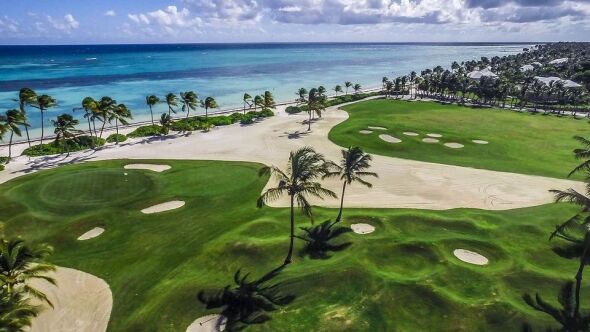
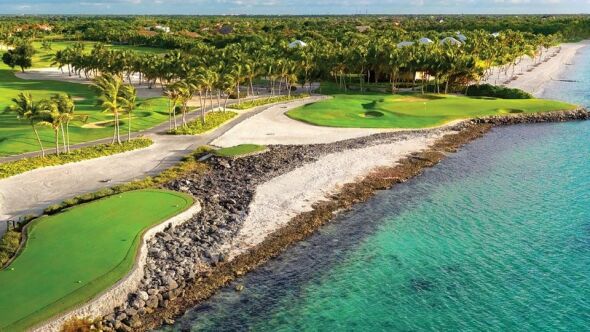
The islands newest course is Punta Cana Resort and Club (888-442-2262), where Pete and Alices son P.B. Dye created a track pocked with pot bunkers and buttressed with palm logs. It has four holes on the water and 14 with ocean views. Lying closest to the mainland U.S. is the 700-island chain of the Bahamas, where island golf dates back to the Roaring 20s, and pioneer designers such as Dick Wilson, Joe Lee and Robert Trent Jones, Sr. struggled to cover rock with enough dirt to grow grass, using equipment that was no match for the coral.
Many of the older tracks (there are seven scattered among the islands) are a joy to play because they are on prime pieces of land and are very natural. But they lack the bells and whistles of modern courses such as the Robert Trent Jones Jr. Reef Course at the massive new Our Lucaya Resort (877-772-6471) on Grand Bahama Island (which also has three older courses that have been refurbished). Or the scenicParadise Island Golf Course (242-363-6682), recently rebuilt by Tom Weiskopf. Paradise Island is connected by a bridge to Nassau, capital of New Providence Island, which also has two classic old tracks.
The buzz in the Bahamas is about Emerald Bay Golf Course (561-417-6906), a Greg Norman layout being built on a spectacular peninsula on Great Exuma, a sleepy Out Island known for great fishing, diving and sailing. The course will be the centerpiece of a Four Seasons Resort opening in early 2003.
At the tail of the Bahamas archipelago lie the Turks and Caicos, islands known mostly to scuba divers and beach lovers. Like most of these islands, Providenciales (Provo) has little fresh water, but that did not stop the Turks and Caicos Water Company from building the Provo Golf Club (649-946-5991) in 1992 as an investment in the islands future. It is a Karl Litton gem, an oasis in a desert of rock, with a charming clubhouse and golf packages with a number of fine resorts.
Also considered semi-arid islands are Aruba and Curacao, in the Netherlands Antilles islands off Venezuela. Aruba is somewhat Americanized from heavy tourist traffic, but Curacao has more of a quaint European atmosphere. The official language is Dutch, but hoteliers and shopkeepers speak English, Dutch and Spanish, and trade in three currencies. The islands two cutting edge courses (Robert Trent Jones Jr.s desert-style Tierra del Sol (011-297-860-978) on Aruba, and Rocky Roquemores lush, seaside Blue Bay (011-599-9-868-1755) on Curacao belong to the same people, who offer a 15-minute helicopter ride between the two courses.
Near Venezuela, but to the east of the ABC Islands of Aruba, Bonaire and Curacao, lies Trinidad and its small sister island, Tobago, a bird-watchers and scuba divers paradise. Tobagos Mt. Irvine Bay Resort and Golf Course (868-639-8871) is a former Johnnie Walker Championship venue and one of the top golf resorts in the region.
Staid, oh-so-British Barbados is north of Tobago and as
far east as you can get in the Caribbean. In 1995, Robert Trent
Jones Jr.s Royal Westmoreland Golf Club (246-422-4653),
routed on a spectacular hillside and through a rock quarry, upstaged
the outdated course at the venerable Sandy Lane Resort
(246-444-2000). Sandy Lane reopened last year with an ultra-luxurious
new hotel, a revamped Old Nine, the Country Club Course
up in the hills, and the promise of the Green Monkey Course
for this year. All are the work of Tom Fazio, who says the newest
addition will be one of the best courses in the world.
So many islands, so many courses, so little time.