


Frog Hollow Golf Club

Rating Snapshot


About
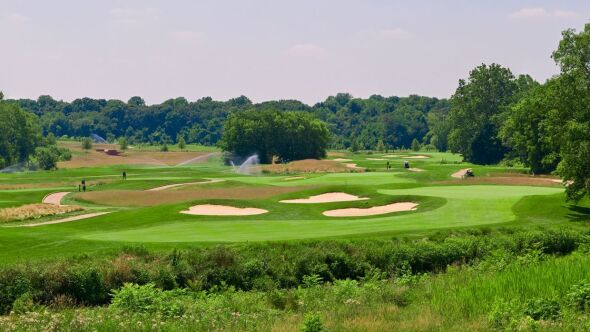
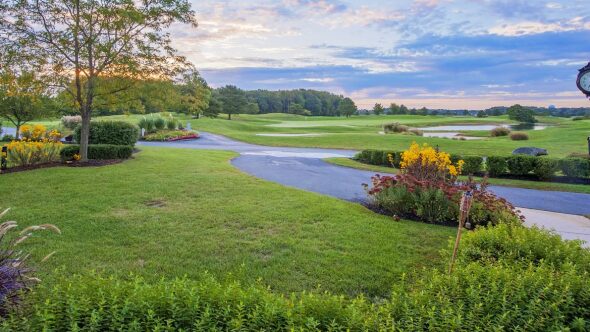
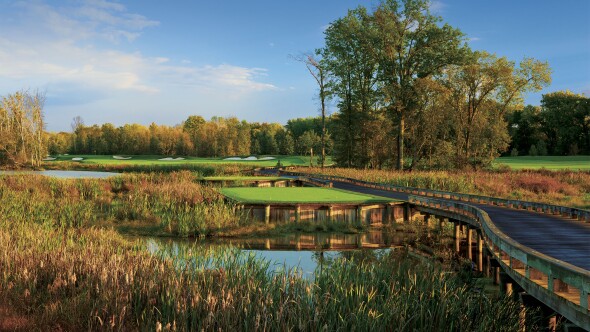
Frog Hollow Golf Club in Middletown boasts the title of "best public golf course" in Delaware. The course has a links-style layout that is challenging but still player-friendly enough to appeal to beginners, seniors, and juniors. The layout is wide open and quite forgiving but there are still plenty of hazards with which to contend. There are more than 50 strategically placed bunkers throughout the golf course. Their thoughtful placement makes up the bulk of the layout's challenges. There are ponds that come into play on six holes as well as tall native grasses that appear along the fairways and greens. The wind is often a factor on the course too and will test your accuracy even further. Frog Hollow Golf Club's par 3s and par 5s are manageable but the par 4s will test even the best players.
| Tee | Par | Length | Rating | Slope |
|---|---|---|---|---|
| Blue | 71 | 6608 yards | 72.3 | 131 |
| White | 71 | 6145 yards | 70.0 | 128 |
| Gold | 71 | 5554 yards | 67.3 | 115 |
| Red | 71 | 4746 yards | 63.7 | 116 |
| Red (W) | 71 | 4746 yards | 67.0 | 113 |
| Hole | 1 | 2 | 3 | 4 | 5 | 6 | 7 | 8 | 9 | Out | 10 | 11 | 12 | 13 | 14 | 15 | 16 | 17 | 18 | In | Total |
|---|---|---|---|---|---|---|---|---|---|---|---|---|---|---|---|---|---|---|---|---|---|
| Blue M: 72.2/128 | 375 | 505 | 166 | 427 | 495 | 209 | 380 | 154 | 369 | 3080 | 394 | 533 | 390 | 360 | 177 | 450 | 219 | 435 | 570 | 3528 | 6608 |
| White M: 69.9/126 | 352 | 480 | 145 | 405 | 470 | 180 | 357 | 135 | 350 | 2874 | 370 | 514 | 360 | 330 | 155 | 417 | 186 | 409 | 530 | 3271 | 6145 |
| Gold M: 67.1/116 W: 71.2/119 | 327 | 465 | 122 | 315 | 395 | 164 | 347 | 124 | 336 | 2595 | 359 | 431 | 354 | 319 | 125 | 410 | 165 | 381 | 415 | 2959 | 5554 |
| Red M: 63.8/114 W: 66.8/113 | 280 | 403 | 101 | 311 | 391 | 140 | 277 | 82 | 270 | 2255 | 291 | 426 | 248 | 223 | 107 | 330 | 127 | 325 | 414 | 2491 | 4746 |
| Handicap | 8 | 6 | 16 | 2 | 10 | 12 | 4 | 18 | 14 | 7 | 13 | 11 | 9 | 15 | 3 | 17 | 1 | 5 | |||
| Par | 4 | 5 | 3 | 4 | 5 | 3 | 4 | 3 | 4 | 35 | 4 | 5 | 4 | 4 | 3 | 4 | 3 | 4 | 5 | 36 | 71 |
| Handicap (W) | 12 | 6 | 16 | 2 | 10 | 8 | 4 | 18 | 14 | 9 | 7 | 11 | 15 | 13 | 5 | 17 | 3 | 1 |
Course Details
Rentals/Services
Practice/Instruction
Policies
Food & Beverage
RestaurantAvailable Facilities
Clubhouse, Banquet FacilitiesAvailable Activities
SwimmingAvailable Sports
TennisAccolades
-
Golf Advisor: Top Courses in Delaware (2023 #8)
Reviews
Reviewer Photos

Poor treatment from owner
Played as single. At #10 came up on league with shotgun start. Was not informed of this. Called clubhouse and was told to go around until I could play holes. I did this and on #11 person on cart who, unbeknownst to me, was the owner. He berated me about driving past groups. Indicated as a single I had no standing. Told me when I came up on next groups I’d need to wait. How would that be for folks behind with a solo golfer in their way. So I played a couple more holes and quit. Went into clubhouse to express disappointment to the pro. That’s when I found out earlier driver was the owner. He continued with abuse of me even tho his employee who told me to drive past groups was right there. He said I was arrogant and entitled and hoped I’d never come back. Well he needn’t worry about that. I’ve played golf for 50 years and have never been so mistreated by staff in this case the course OWNER!! There was at least 2 other ways to handle this. Issue a 9 hole rain check or tell me I could restart on #1 to be able to play the round I paid for. Instead he bullied me, disrespected me and said he hopes he never sees me again. Other review sites have documented this man’s mistreatment of golfers. To say that a paying customer regardless of being a single has no standing is totally outrageous. This man has no business being in charge of a golf course. It’s unfortunate that a nice course like this is run by a complete bully with absolutely no understanding of the proper way to treat people.
Better than it's ever been
If you like super fast undulating greens you have to play Frog Hollow. I was told there is new management in place and it showed in the course conditions. For April 14, the course was in remarkable shape. Even on short holes that could be birdie opportunity, the undulating greens can quickly turn a 15 foot putt into a 3 putt that would normally never happen. The staff is nice and the value for golf here is as good as it gets. Our round was so enjoyable.
Nice day to play but ranger needed
The day started out gloomy and wet. Cart-path only was understandable. The problem is when people who don’t know to move forward with the cart or everyone in the group shouldn’t go to each shot or take 2 clubs with you if your not sure.
People who do not know golf etiquette is bad enough but much worse if there is no ranger to move groups along. Courses today are afraid to offend people who play 1 time every 2 months. Close the open holes please. I had 2 teenage boys hitting 4 tee shots each as the balls go in the water before they get off the box. Not just here, its everywhere. Golf courses, please get it together. Pace of play is important.
First round of the year
Frog hollow has been a go to place for a while now. They continue to keep rates reasonable and continue to do improvements on the course. Bunker reshaping with new sod in place. Fairways were aerated recently. Noticed a lot of tall grass/weeds, overgrowth taken down. Should help the course grow better and dry from rain quickly. Cary path only on Easter , but finished in just over 4 hours. Should be another solid summer at Frog Hollow. Be back soon!!
Good course
Good course as always, but shouldn't let people buy an 18 hole round if at the turn there is going to be a high school tournament going on and the round will be cut to 9.
nice winter day
Greens were rolled and cut day before and are in top quality shape. Kudos to crew there. Putts were true & fast,NICE. More sand in bunkers and raked would be good also ; but it is still winter. Shoot 78 w/ opts for birdies on 7 holes. Only got 1.
My group absolutely likes Frog Hollow.
The 🐸 is a very nice course. they are constantly upgrading the condition. Played there last week, and seen many workers preparing fairways, and reshaping the bunkers..
Highly recommend Frog Hollow, if you haven't played this course put it on your short list.

Go, play Frok Hollow
I am not a golf snob. It's early in the season. Unusually warm couple of days. Pro shop to 18th green was a good experience. Greens were lightning fast and ya'll know they are not flat. I enjoy a good challenge. You had to think twice before putting and pay attention to the others putting as well. Also new sand is being delivered to the traps. Had a good time and made two new friends. Like I said, it's early in the season. It will only get better.
On the Way Back
With proper expectations, Frog Hollow is certainly a good value if you can get greens fees at $50 or less. It is a challenging course with a lot of fun holes and challenging greens - many with trouble lurking off the edges. (Don’t be long on 1!)
A handful of holes had mats in front of the tee boxes and a couple of fairways were aerated with plugs left in place (literally covering the entire fairway).
Some traps were lakes, some were brand new and one had a bunch of workers in it doing repairs.
The greens were good and the fairways were, too for the most part but it’s a shame how many divots and ball marks were left unrepaired. The last 50 yards of several holes were covered in unrepaired divots. A shame.
The carts are gas and chug along at an acceptable, if slowish, pace. No GPS.
Pro shop attendant was courteous. The bar/restaurant was closed but I was told it is open from Wednesday to Sunday and more days will be added as the weather improves.
No beverage cart on the course. No water.
I would like to play this course again in a month or two when temperatures rise.
If the course was in bloom and all the tee blades were open, I think the other negatives would not have been as noticeable. But in March, there’s not much else to look at - except the scorecard and I try not to do that.
Hello, u000002931907. Thank you for leaving us a review. We are sorry to hear your experience was anything short of 5 stars, but we hope you will give us another try in the future. Thank you for choosing Frog Hollow Golf Club.
Warm and sunny on a Monday in march
Well my buddy never showed up/ tee time at 1:20
Starter said I could go out wasn’t busy in the afternoon/ let husband and wife by me felt like they were always hitting up on me/ beautiful out, I played 9 they left the course , played back nine and few groups out had wonderful afternoon. Want to stop back get sweatshirt from pro shop/ do some free advertising for them to go with my frog hollow hat. Was still winter conditions but they had started clearing all the brush from around the ponds . Great time I will be back 🤠
Plan to go back
First time playing here. Long drive from my area but it was worth it. Would like to play in the warm weather because the course is a good value for the cost to play.
Great winter golf conditions
Play here often and it was a pleasure as expected.
Great Course, nice layout
Have played here many times and enjoy the course. The Staff are very friendly and helpful. Course is challenging, but if you keep it in play you can score well. Greens are fast, a must play.




Seaview Stay & Play Golf Package
Bear Trap Dunes Stay & Play Package
Lansdowne Resort Stay & Play Golf Package

Shadowbrook Stay & Play Package

Hello, Amorse2721. Thank you for leaving us a review. We are sorry to hear your experience was anything short of 5 stars, but we hope you will give us another try in the future. Thank you for choosing Frog Hollow Golf Club.