Blue Heron Pines Golf Club

Rating Snapshot


About
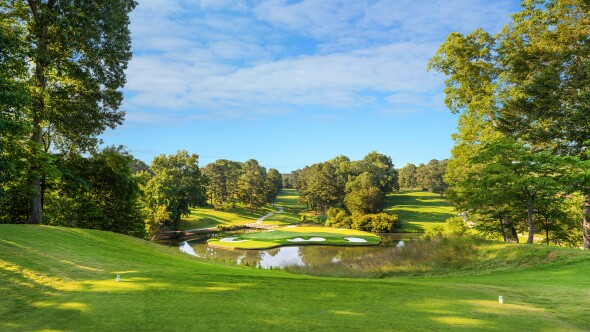
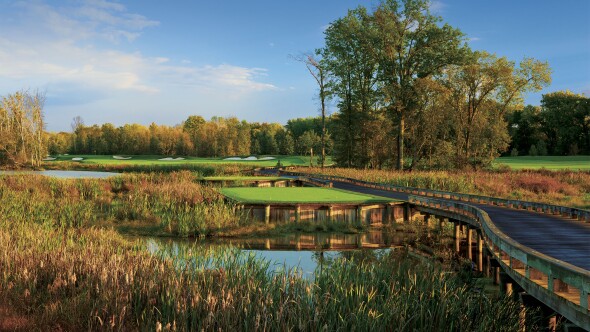
The Blue Heron Pines Golf Club consists of two award-winning courses called the East and the West. Located 15 minutes outside of Atlantic City, these public golf courses provide a challenging game and have been touted by many New Jersey publications as the best 18-hole course on the Jersey Shore.
Each golf course had a different designer so they do have some differences. The West Course is relatively flat with narrow fairways and fast greens. Water hazards also come into play on seven holes. The East Course on the other hand features wide fairways and difficult bunkers. The East Course also follows a links-style layout and is meant to be played fast and firm. For those who want to play the courses but aren't at the top of their game yet, the club offers golf instruction.
| Tee | Par | Length | Rating | Slope |
|---|---|---|---|---|
| Black | 72 | 6810 yards | 72.2 | 133 |
| Blue | 72 | 6619 yards | 71.1 | 130 |
| White | 72 | 6207 yards | 69.6 | 127 |
| Gold | 72 | 5604 yards | 67.3 | 122 |
| Red | 72 | 5108 yards | 69.0 | 120 |
| Hole | 1 | 2 | 3 | 4 | 5 | 6 | 7 | 8 | 9 | Out | 10 | 11 | 12 | 13 | 14 | 15 | 16 | 17 | 18 | In | Total |
|---|---|---|---|---|---|---|---|---|---|---|---|---|---|---|---|---|---|---|---|---|---|
| Black M: 72.0/132 | 315 | 180 | 533 | 183 | 413 | 412 | 323 | 577 | 422 | 3358 | 395 | 130 | 415 | 374 | 518 | 421 | 218 | 451 | 530 | 3452 | 6810 |
| Blue M: 70.8/130 W: 74.7/134 | 309 | 165 | 523 | 173 | 407 | 402 | 310 | 570 | 415 | 3274 | 388 | 125 | 405 | 365 | 493 | 408 | 208 | 438 | 515 | 3345 | 6619 |
| White M: 69.3/127 W: 73.4/131 | 290 | 155 | 495 | 163 | 390 | 375 | 295 | 530 | 376 | 3069 | 367 | 115 | 386 | 342 | 483 | 390 | 177 | 405 | 473 | 3138 | 6207 |
| Gold M: 67.1/123 | 278 | 132 | 471 | 151 | 352 | 348 | 265 | 465 | 342 | 2804 | 332 | 103 | 373 | 326 | 368 | 335 | 151 | 351 | 461 | 2800 | 5604 |
| Red M: 64.6/117 W: 68.9/122 | 221 | 119 | 428 | 138 | 348 | 280 | 225 | 443 | 308 | 2510 | 315 | 90 | 330 | 305 | 358 | 321 | 132 | 342 | 405 | 2598 | 5108 |
| Handicap | 18 | 16 | 8 | 14 | 2 | 4 | 10 | 6 | 12 | 7 | 17 | 5 | 13 | 3 | 1 | 11 | 9 | 15 | |||
| Par | 4 | 3 | 5 | 3 | 4 | 4 | 4 | 5 | 4 | 36 | 4 | 3 | 4 | 4 | 5 | 4 | 3 | 4 | 5 | 36 | 72 |
Course Details
Rentals/Services
Practice/Instruction
Policies
Food & Beverage
Bar, Snacks, Grill, RestaurantAvailable Facilities
Clubhouse, Banquet Facilities, ShowersReviews
Reviewer Photos

Great course for the money
always enjoy the course. The starter is a
Tremendous person
A very beautiful course.
Since we played it in the late Fall it was tough locating the balls in the rough. The foursome agreed to play again in season.
Nice course
I warmed up on the range, rolled a few puts, felt great. Then came the tee shot fore right, and so on and so on., water holes homes, gotta hit em straight.

Blue Heron Pines
Great day to play. The course was in very good condition. The tees were good, the fairways were very good, and the greens were close to excellent. The drink cart person (young female type) was very pretty nice (pretty and nice) and we saw her 4 times during the round - she was the only one doing that. Got free range balls because they were updating systems. There was also a female cancer awareness tourney that was starting after we came off of 9, so we were privy to more than a few new female smiles riding by.the many happy, smiling new to us female faces. Beautiful event.
Pace of play
The course needs a marshall. Slow groups who don't know the importance of pace of play ruin an otherwise nice day.5 groups should not end up on 15 and 16 while 17 and 18 have no one on them. Help!
Go Eagles
Nice track was windy before big storm only played 9 holes but was nice.
Excellent course
Always wanted to play here, but always saw the price was out of budget for me. Glad golf now was able to advertise a reasonable price for this excellent course.
Great conditions for time of year
Course is in great condition considering how late in the season it is. All the staff is super friendly especially Gary.
Great Course
Course is in good shape considering how late it the season it is. Staff is super friendly and very helpful. Gary and Alex are great!





Seaview Stay & Play Golf Package
Bear Trap Dunes Stay & Play Package
Lansdowne Resort Stay & Play Golf Package

Shadowbrook Stay & Play Package