Along With
Your Sticks, Bring Some
Hiking Boots To Lansdowne
By Jeffrey A.
Rendall, TravelGolf.com Staff Writer
Leesburg, VA - The yardage book for the Robert Trent Jones
Jr. designed Lansdowne Resort's golf course contains a greeting
from the architect himself, where he introduces the layout and bids
you good tidings for your trip around his creation.
The message is typical of one you'd expect to hear from the famous
architect of any upscale golf course, but there was one thing that
Jones Jr. highlighted that stood out--elevation changes.
Another clue to what lies ahead is that the course bills itself
as part of Virginia's renowned hunt country--so a visit here would
be accompanied by 'hunt country' characteristics--undulating ground,
postcard scenery, and the thrill of the chase. For those hoping
to experience these phenomena at Lansdowne, there is no disappointment.
I've often thought that when God was creating Virginia, he couldn't
make up his mind whether to make it flat like the Texas panhandle,
or mountainous like West Virginia--where the only flat piece of
ground you'll get is one that a bulldozer will give you. So, for
Virginia, he compromised--the terrain isn't so mountainous that
you'd need to be a goat to get around, nor is it so flat that you
can see both horizons without a ripple to interrupt the view.
Lansdowne is a perfect embodiment of God's Virginia compromise.
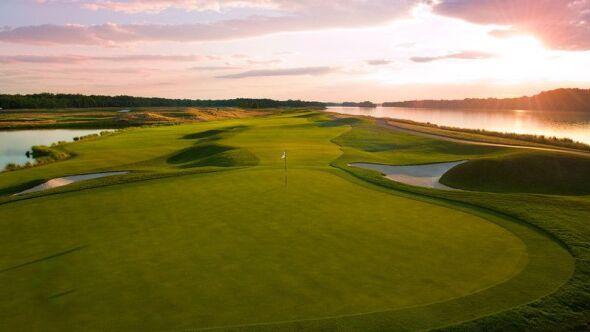
The layout presents the best of both extremes--some mildly undulating
holes to help build confidence in the first nine--and some dramatic
elevation changes to test your skills on the inward holes.
This being said, the course is also player friendly. Lansdowne
would make an excellent test case for any professor lecturing on
what a resort course should look like-- wide fairways, generous
rough bordering them (to keep your ball from reaching the real trouble),
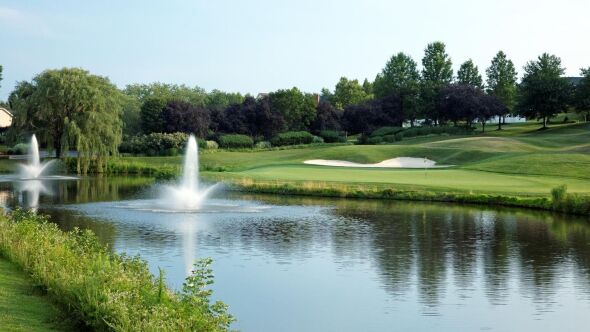
undulating multi-tiered putting surfaces, plenty of water (but in
player friendly places), and lots of variation. Creative design
features to penalize you, but not to punish you.
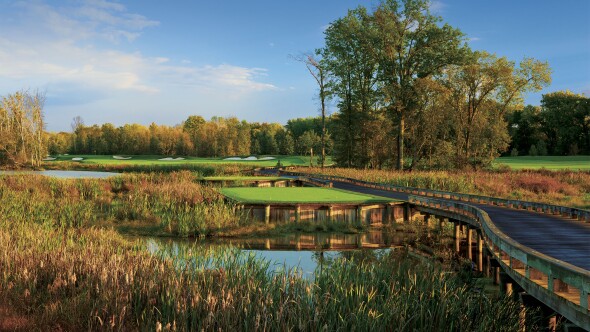
Accenting the design is the course's condition--which is excellent;
it would be difficult to find a patch of ground that isn't lush
green, sandy, or covered with H2O. Doug Rook, Lansdowne's Director
of Golf Operations, gives credit to the Zoysia grass for the course's
pleasing looks; he says "the Zoysia grass we use for the fairways,
which not too many courses around here have, allows us to keep the
course in better condition and more playable year round."
The 'meat' of the course is on the back nine, but the front deserves
some special notations also. The first two holes are relatively
straightforward par fours--which allows for a good warm up in case
your stretching routine hasn't quite done the trick. Pleasant to
look at, but nothing that will make your knees quiver.
The third hole offers the first mental test, a sharp dogleg left
that calls for a well placed drive and approach shot to give yourself
a birdie try. Totaling 353 yards from the back, it's not really
a driveable hole (it's about 280 to cut the corner, all carry)--but
still requires strategic thinking on the tee box. There's trouble
on the left in the form of a shallow bunker, and a marshy pond waits
for anything hit wide or over the sand. A bunker protects against
a drive hit through the fairway long, and more sand guards the right
hand side.
Smart play calls for a long iron or even a five wood off the tee,
which will leave a wedge into the green. The nice thing about the
hole is the bigger the gamble off the tee, the easier the second
shot will be--because greater distance will mostly take the pond
on the left side of the green out of play.
The balance of the outward nine provides more opportunities to
weigh club selection against potential troubles. The eighth hole
is a slightly downhill par five that's definitely reachable in two
if you can avoid the 14 bunkers on the hole--primarily placed on
the right hand side.
Players that fade will especially enjoy the tee shot--due mostly
to a large dead tree that guards the right hand side--unless you
fade too much. The fairway bunkers are definitely to be avoided--if
you're in one of them, you'll probably have to use a short iron
for a layup.
It's hard to highlight just a few holes on the back, for all but the
first two could probably make some courses' signature list. Quite
frankly, there's something for everyone here.
Rook adds "The back nine, starting with the 12th on--contains
one of the best stretches of holes in the mid-Atlantic." I
agree. The 12th presents a split fairway tee shot, with a rock channel
dividing the two landing areas. The second shot is all uphill, and
sets the tone for the balance of the backside--elevation changes!
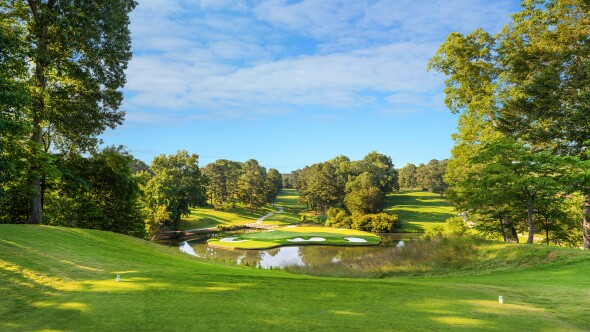
The 13th is a beautiful downhill par three that requires tee shots
to carry a stream along the front and left side. Bunkers protect
the right for those bailing out on the 'safe' side. Precise club
selection is a must here--the green is 50 feet below the back tees,
and even a breath of wind will be a factor. You're assured of getting
a good high approach--you just better know your 'air' and how much
you'll require to put the ball on the green.
The next two holes have less undulation, but quite a lot of challenge.
The 14th is a three shot par five for all but tour pros, and players
must successfully negotiate steep bunkers on both sides of the fairway
to have a chance at the green in regulation. Also notable is the
stone wall that separates the cart path from the fairway on the
latter third of the hole.
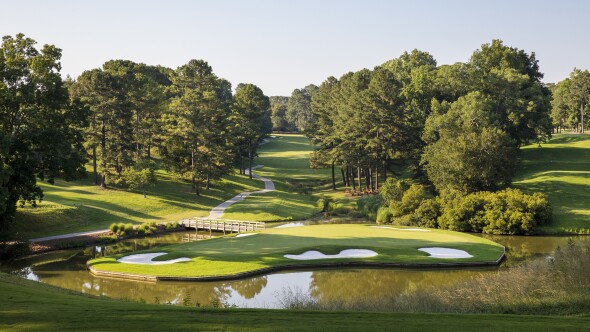
Scenic and historic--it's 260 years old. The 15th is an aesthetically
pleasing 203 yard par three that mandates a full carry over water.
Here again, Jones Jr. gives the resort player a break by providing
a generous bail out area on the left hand side for those who shy
from the challenge of carrying the wet stuff.
The three finishing holes will test every player's ability to
deal with elevation changes. The 16th is an uphill dogleg left,
with the second shot to the putting surface rising nearly 50 feet
above the landing area for tee shots. The 17th tee is 100 feet above
the green. Tee shots struck well will give you bragging fodder (in
terms of distance) for your usual playing partners who weren't fortunate
enough to make the round (just omit the details of the hole)--the
ball seems to hang up forever before reaching the landing area.
The 18th is the opposite of the previous hole. The tee shot will
bring your driving average more down to size, and the second shot
requires a couple extra clubs to even make the green. I can't recall
three consecutive holes on any other course that are so varied and
difficult.
|
Conditions: A
Layout: B
Service: B
Practice Fac.: B+
Clubhouse/Pro Shop: A-
Pace of Play: B+
Resort Hotel: A
Value: B
Overall Rating: B+ |
|
After you've finished the 18th, you'll probably be in need of some
relief. All that you'll need can be found at or near the Pro Shop.
There are several distinct advantages to playing a round at a resort
as nice as Lansdowne--many of which can be summed up in the type of
services you can get after your round.
In addition to the excellent bar and grill located adjacent to
the fully stocked pro shop, there's a men's and women's locker room
located a short walk down the hall. The locker room features ample
space and all the amenities you'll require--including a jacuzzi
to ease those sore leg muscles from walking the back nine (even
in a cart, you'll still need your hiking boots).
All in all, I'm glad that Jones Jr.'s short soliloquy in the yardage
book prepared us for the round at Lansdowne. If he hadn't, we might
still be looking for the Gondola to get to the top of the 18th!
Lansdowne Resort
44050 Woodridge Parkway
Leesburg, VA 22075
Telephone #: (703) 729-8400
www.lansdowneresort.com
Director of Golf: Doug Rook
Head Pro: Scott Purpura
Rates (In Season):
Mon-Thur $85
Fri-Sun $100
Resort Guests $85
Note: There are separate rates for Groups, Local Outings and Twilight
play.
|