St. Alban's Golf Club:
Better Bring Your Driver
By Carl W. Grody,
TravelGolf.com Staff Writer
ALEXANDRIA, Ohio - Are you ready for a challenge? How about 610
yards of a challenge?
That's right. One hole, 610 yards. The faint of heart need not
apply.
St. Alban's Golf Club is the place for this monster par five, and
you'd better bring your driver. Even from the white tees, St. Alban's
17th hole plays 550 yards.
But before you decide to play somewhere else just to avoid embarrassment,
think again. St. Alban's is an above-average public golf course.
The cost is low, the design is challenging, the area is tranquil,
and the 17th plays downhill - well, at least the approach shot does.
St. Alban's is unusual for a central Ohio course because it has
hills. Real hills, too, not those wimpy mounds that many courses
call hills in the flatland that is central Ohio.
We're talking about hills suitable for mountain goats. We're talking
about hills that will give the experienced walker a good workout.
We're talking about hills that would put someone with a heart condition
in the hospital (when in doubt at this course, drive a cart).
St. Alban's was built in 1987 by course manager Tony Price, but
the layout doesn't smack of amateurism at all. You occasionally
have to duck a ball flying in from another fairway, but when you
hit the back nine, you're transported into a new world of trees,
hills, and golf challenges.
What you don't run into is a lot of people because St. Alban's
is off the main track; it's one-and-a-half miles north of Alexandria,
31 miles northeast of downtown Columbus. The surrounding neighborhood
includes farms, a truck-repair Service, and a small business that
sells Chrysalis Amethyst Healing Stones. (There's no truth to the
rumor that the stones help on the 17th hole.)
St. Alban's - a par 71 course - plays 6,732 yards from the blue
tees with a rating of 71.6 and a slope of 112 (which is too low).
But don't let the length intimidate you. From the whites, the course
plays a serene 6,115 yards with a rating of 68.8. St. Alban's can
play easy or hard, depending on your mood - and talent.
There are a few problems for the average golfer. The signs on each
tee box show no hint of the direction of each hole; you'll have
to consult the diagram on your scorecard on a regular basis. Many
shots on this course are blind, including several tee shots, and
if you don't know where you're supposed to go, you can get in big
trouble.
St. Alban's is also a "feel" golf course. The only yardage
markers on the course are the plaques at 150 yards; if you're not
close enough to pace off your yardage, you'll either have to rely
on your ability to "feel the shot" or just downright guess.
On the greens, feel will be important as well. The greens are slow
but subtle, with small mounds that sometimes leave you clueless
about the direction of a putt.
There's also a dearth of drinking water on the course. There's
a drinking fountain available about halfway through each of the
nines, but that's not enough to get you from getting dehydrated
- especially if you're walking. Take at least one bottle of water.
But from the first tee shot on, you won't regret playing St. Alban's.
The first hole dips so suddenly from the tee that you can't see
the fairway of this 322-yard (from the whites) par four that doglegs
left. But you can see the green, and if you're a big hitter, you
can drive it; just avoid the bunker on the left side of the hole
that guards against just such attempts. If you lay up, you'll have
no more than a short wedge to a long but thin green.
Take advantage of the ease of the first hole because the second
is a lot tougher. There's a pointless pond in front of the tee that
serves no purpose other than to intimidate poor golfers, but once
you clear that, this hole is 392 yards with a dogleg left.
A good driver will leave you with about 150 yards to the heart-shaped
green, which is the opposite of the first green - wide but not very
deep. When the pin is tucked on one of the upper cheeks of the heart,
it makes for a tricky approach.
After a fairly simple par three, the par-four fourth continues
with the blind shot theme. The fairway rolls on this 372-yard hole,
and your tee shot will finish at the bottom of a hill. As you walk
off the tee, size up your shot and pick a target for your approach
because you won't be able to see the green when you reach your ball.
Price played tricks with your eyes on the par-3 sixth hole as well.
It's 162 yards to an extremely wide target, but there's a large
tree guarding the left third of the green. The tree is so tall that
you feel like you need a wedge to clear it, but you don't. The tree
is actually a good distance short of the green, but going for any
pin tucked behind the tree would be a mistake in course management
(in layman's terms, that means it would be stupid).
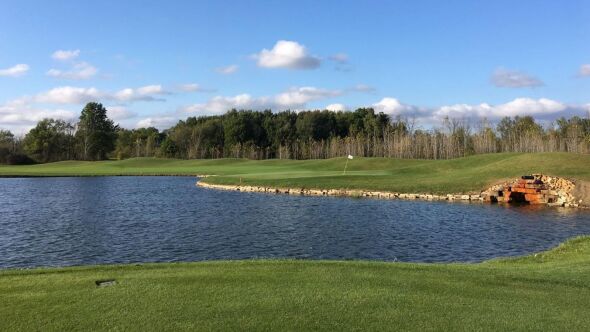
There's also a pond tucked in a valley left of the tree, and you
won't see it until you walk to the hole. Hit the middle or right
side of the green, two-putt for par, and enjoy your walk to the
next hole.
At the seventh tee, though, remember that you love a challenge.
It's a 531-yard par five - 585 yards from the blue tees - with out-of-bounds
along the right side. You can't bail out too far left, though, because
you're hitting through a tunnel of trees.
And forget about reaching the green in two. The hole plays uphill,
the green is too small to hold a long iron or fairway wood, and
there's a pond lurking - blind to your eye, of course - immediately
behind the green.
Things get even tougher on the par-four eighth hole, especially
from the blue tees, where it's 471 yards. The whites play just 423
yards, but the green is another small, heart-shaped affair that
prefers wedge shots. If you're playing anything longer than a nine-iron
on your approach, aim for the left side of the green and try to
bounce the ball onto the putting surface.
The ninth is the second par-five, a more manageable 503 yards (527
yards from the blues). The tee shot is again through trees to a
fairway sloping uphill.
Your second shot will be - you guessed it - blind, and the green
is again small. It's protected by mounds to the left, right, and
back of the green, but there is an opening in front where you can
run your ball onto the green. Once you're there, you'll battle an
even greater foe - the mesquite smoke from the nearby grill. If
there's an outing in the pavilion, you'll need to hit the ball between
coughing fits.
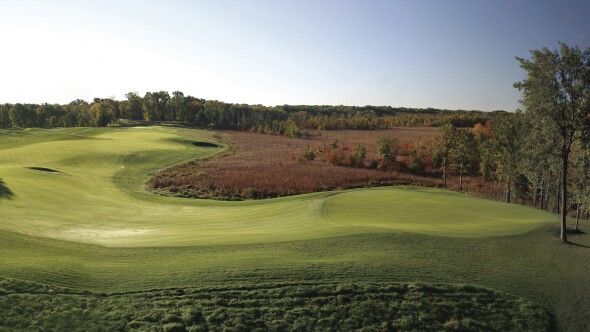
The 10th hole is the most majestic on the course. It's 410 yards severely
downhill, and to get to the green, your approach shot must travel
over a creek and through woods on either side of the fairway. From
the tee, the hole looks gorgeous.
From the fairway preparing to hit your second shot, the hole looks
intimidating. From the rough on either side of the fairway, the
hole looks like an exercise in cruelty.
But even if you make a big score on number 10, you'll enjoy this
part of the course. The 11th is a 375-yard par four that doglegs
sharply to the right, then climbs to an elevated green - two extra
clubs of elevation, at least - surrounded by a drop-off to the left
and right. And if you hit your approach short and left, there's
a strand of trees that will gobble up your ball.
One member of our party actually hit his ball into a pine tree,
where it nestled among the needles and never came out. It's probably
still there, causing a mother bird to wonder if she forgot to hatch
one of her eggs.
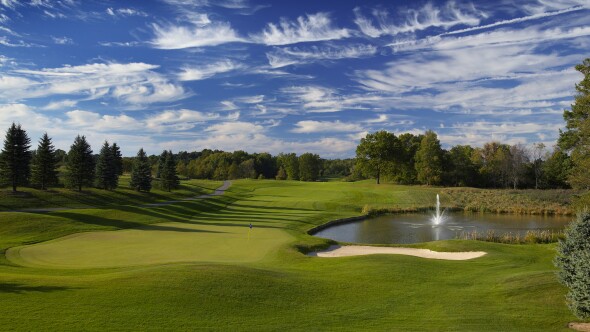
The 12th hole is a 152-yard par three that again travels downhill
between trees. Your tee shot has to clear a pond about halfway to
the target, and large mounds surround the long, thin, diagonal green.
The only place to miss the green and still have an easy pitch is
short of the green; anywhere else, and you'll have a downhill pitch
off a downhill lie. And because the green is so thin, almost every
pin position will seem like it's tucked away.
The 13th hole is a simple par-five from the whites, 480 yards, with
out-of-bounds on the right side. A creek crosses the landing area
for your tee shot, but you have to hit the ball flush to reach it
- especially from the blues, playing 560 yards. But if your tee
shot is in the fairway, neither this hole nor the straightaway par
four 14th causes many problems.
That's not true at number 15. There, you're trying to hit a green
tucked into a nest of trees. There's a creek that goes completely
around the green, and if you're offline by just a smidgen, you're
staring at double-bogey. But the hole plays just 105 yards from
the whites, 145 yards from the blues. If you ignore the trouble
and make a good swing, you can enjoy the shade as you stroll to
the ball.
The biggest challenge on the par-four 16th is probably surviving
the walk to it. Where 15 plays in a valley, 16 plays on top of a
hill. If you're walking, your heart will be pounding by the time
you reach the tee. Forget the honor system; first one to catch his
breath gets to tee off.
You've caught your breath by the monster 17th, but your heart
will still be beating so hard that you could count the beats by
watching your chest bounce. The tee shot is actually pretty simple,
especially if you don't try to swing too hard.
Be happy with putting your ball in the fairway, no matter how far
you are from the hole. The second shot is blind - gee, what a surprise
- leaving you to imagine all sorts of horrible fates for your lay-up.
All you can see is a dip in the fairway and trees in the distance.
The green will be slightly to your right, but ignore the temptation
to cut the corner. Instead, stay left and hit it down the middle
of the fairway. If you catch this shot flush, your ball will disappear
past the dip and roll down a hill so steep it could probably double
as a ski slope in the winter.
The roll will leave you surprisingly close to the green - maybe
even within 100 yards - and you'll be stunned by how quickly you've
covered five football fields.
The 17th features two greens - one lower and to the left - and
your approach from the fairway will be simple. By this point, a
par doesn't seem so hard, and you'll walk away feeling Tigeresque.
(Until, of course, someone reminds you that Tiger would've hit the
hole in two with a three-iron and probably made eagle; if that happens,
leave that person home the next time.)
The 18th will take the shine out of your eyes, though. It's 153
yards uphill - and we're not talking about a gradual slope, either.
The green is so high that you can't see it. You might see the flag,
but just barely.
This is just another of Price's blind shots that requires faith
and discipline. Aim left of the large pine tree by the cart path,
hit the ball high and straight, then dig in your heels as you trudge
up the hill.
If you've ridden a cart around St. Alban's, you'll be excited
about the golf course and probably want to stop in the snack shop
to boast about your round. If you've walked the golf course, you'll
probably want to stop in the snack shop to catch your breath, rehydrate,
and ask if there really were mountain goats near the 16th tee.
Either way, St. Alban's will be the kind of place you want to experience
again, especially since the next time you'll know where each hole
is actually going.
St. Alban's Golf Club
3833 Northridge Road
Alexandria, OH 43001
Phone: (740)924-8885
www.centralgolfohio.com |